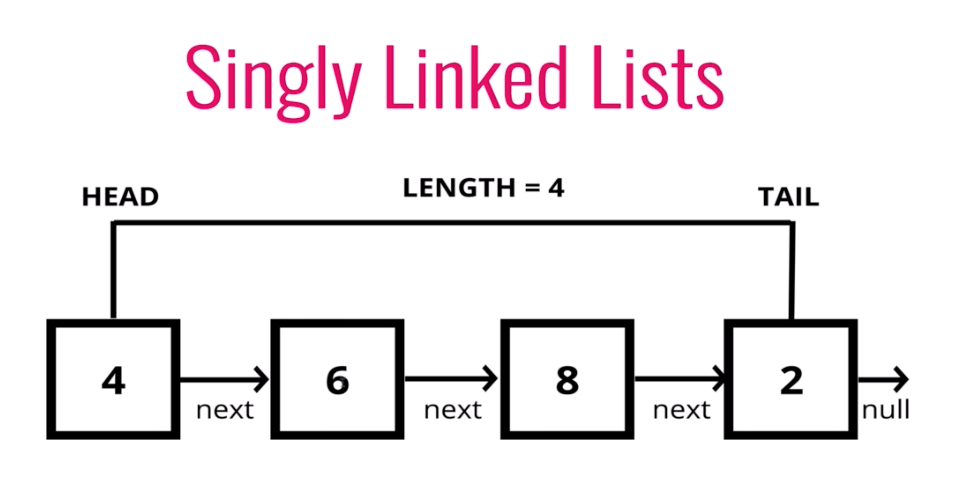
- Data structure that contains a head, tail, and length property
- Consist of nodes and each node has a value and a pointer to another node or null
- Types of Linked Lists:
- Singly Linked
- Nodes have a single pointer connecting them in a single direction.
- Doubly Linked
- Nodes have two pointers connecting them bi-directionally.
- Multiply Linked
- Nodes have two or more pointers, providing a variety of potential node orderings.
- Circularly Linked
- Final node's next pointer points to the first node, creating a non-linear, circular version of a Linked List.
-
- Do not have indices!
- Connected via nodes with a next pointer
- Random access is not allowed
-
- Indexed in order!
- Insertion and deletion can be expensive
- Can quickly be accessed at a specific index
  class Node {
      constructor(val) {
          this.value = val;
          this.next = null;
      }
  }

  class LinkedList {
      constructor() {
          this.head = null;
          this.tail = null;
          this.length = 0;
      }
} -
Adds a new node to the head of the Linked Lists
-
Returns an Updated Linked List
// Should accept a value
addToHead(val) {
  // Create a new node using the value passed to the fn
  let newNode = new Node(val);

  // If there is no head property on the list
  if(!this.head) {
    // set the head and tail to be the newly created node
    this.head = newNode;
    this.tail = newNode; // or this.head??
  } else {
    // otherwise set the newly created node's next property to be the current head property on the list
    newNode.next = this.head;
    // set the head property to be the new node
    this.head = newNode;
  }

  // increment the length by 1
  this.length++;
  //return the linked list
  return this;
}
-
Adds a new node to the tail of the Linked List.
-
Returns an Updated Linked List
// Should accept a value
addToTail(val) {
  // Create a new node using the value passed to the fn
  const newNode = new Node(val);

  // If there is no head property on the list
  if(!this.head) {
    // set the head to be the newly created node
    this.head = newNode;
  } else {
    // Otherwise set the new property on the tail to be the new node
    this.tail.next = newNode;
  }

  //set the tail property to be the newly created node
  this.tail = newNode;
  // increment the length by one
  this.length++;
  return this;
}
-
Inserts a new node at the "index", or position, specified.
-
Returns a Boolean
//Should accept an index and value for insertion
insert(index, val) {
  // If the index is less than zero or greater than the length, return false
  if (index < 0 || index >= this.length) return false;
  // If the index is the same as the length, push a new node to the end of the list
  if (index === this.length) return !!this.addToTail(val);
  // If the index is add a new node to the start of the list
  if (index === 0) return !!this.addToHead(val);

  const newNode = new Node(val);
  // Access the node before the insertion point
  const prev = this.get(index - 1);
  // Save the node at insertion point to a variable
  const temp = prev.next;
  // Set the node at the insertion point to the new node with the value passed in
  prev.next = newNode;
  // Set the the property replaced at insertion point to be next property after new node
  newNode.next = temp;
  // increment the length
  this.length++;
  return true;
}
-
Removes the node at the head of the Linked List
-
Returns Removed Node (Head)
  removeHead() {
      // If there are no nodes, return undefined
      if (!this.head) return undefined;
      // Store the current head property in a variable
      const currentHead = this.head;
      // Set the head property to be the current head's next property
      this.head = currentHead.next;

      // Decrement by 1
      this.length--;
      if (this.length === 0) {
          this.tail = null;
      }
      // Return the value of the node removed
      return currentHead;
}
- Removes the node at the tail of the Linked List
- Returns Removed Node (Tail)
  removeTail() {

      // If there are no nodes in the list, return undefined
      if (!this.head) return undefined;
      let current = this.head;
      let newTail = current;
      // Loop through the list until you reach the tail (there is a next node)
      while (current.next) {
          newTail = current;
          current = current.next;
      }
      // set the tail to be the 2nd to last node
      this.tail = newTail;
      // set the next property of the 2nd to last node to be null
      this.tail.next = null;
      // decrement the length of the list by 1
      this.length--;
      if (this.length === 0) {
          this.head = null;
          this.tail = null;
      }
      // return the value of the node removed
      return current;
}- Removes an element from the Linked List.
- If found, returns the removed element
- If it's not found, it returns -1
  // removes a given element from the list
  removeElement(element) {
      var current = this.head;
      var prev = null;

      // iterate over the list
      while (current != null) {
          // comparing element with current element if found then remove the and return true
          if (current.element === element) {
              if (prev == null) {
                  this.head = current.next;
              } else {
                  prev.next = current.next;
              }
              this.size--;
              return current.element;
          }
          prev = current;
          current = current.next;
      }
      return -1;
}- Removes the node at "index", or position, specified.
- Returns Removed node
  // Should accept an index of node to be removed
  remove(index) {
      // If the index does not exist in the list, return undefined
      if (index < 0 || index >= this.length) return undefined;
      // if the index is 0, remove the first node
      if (index === 0) return this.removeHead();
      // if the index is the last node in the list, remove the node
      if (index === this.length - 1) return this.removeTail();

      // Otherwise access the node before the node to be removed
      const previousNode = this.get(index - 1);
      // save the node to be removed as a variable
      const removed = previousNode.next;
      // set the next property on that node to be the next of the next node
      previousNode.next = removed.next;

      // Decrement the length
      this.length--;
      // return the value of the node removed
      return removed;
}- Searches the Linked List for a node with the value specified
- Returns a Boolean
  // Should accept a search value
  contains(target) {

      let node = this.head;
      // Loop through the list
      while (node) {
          // If the current node value matches the target, return true
          if (node.value === target) return true;
          node = node.next;
      }
      return false;
}- Gets node at the "index", or position, specified.
- Returns Node at index
  // Should accept an index
  get(index) {
      // If the index does not exist in the list, return null
      if (index < 0 || index >= this.length) return null;
      let counter = 0;
      let current = this.head;
      // Loop through the list until you reach the index
      while (counter !== index) {
          current = current.next;
          counter++;
      }
      // return the node at that specific index
      return current;
}- Updates the value of a node at the "index", or position, specified.
- Returns a Boolean
  // Should accept a value and an index of node to update
  set(index, val) {
      // Access node at specified index
      const foundNode = this.get(index);
      // If the node is found
      if (foundNode) {
          // set the value of that node to be the value passed to the fn
          foundNode.value = val;
          return true;
      }
      // Otherwise (if it is not found) return false
      return false;
}- Returns the current length of the Linked List as an integer
  size() {
      return this.length;
}- LIFO (Last in First Out) data structure
- The last element added to the stack will be the first element removed from the stack
- The Call Stack is a Stack data structure, and is used to manage the order of function invocations in your code.
- Browser History is often implemented using a Stack, with one great example being the browser history object in the very popular React Router module.
- Undo/Redo functionality in just about any application
top- first node in the stackbottom- last node in the stacklength- number of nodes in the stack
class Node {
  constructor(val) {
    this.value = val;
    this.next = null;
  }
}

class Stack {
  constructor() {
    this.top = null;
    this.bottom = null;
    this.length = 0;
  }
}- Adds a Node to the top of the Stack
- Returns new size of stack
  push(val) {
    const newNode = new Node(val);
    if (!this.top) {
      this.top = newNode;
      this.bottom = newNode;
    } else {
      const temp = this.top;
      this.top = newNode;
      this.top.next = temp;
    }
    return ++this.length;
}- Removes a Node from the top of the Stack
- Returns Node removed
  pop() {
    if (!this.top) {
      return null;
    }
    const temp = this.top;
    if (this.top === this.bottom) {
      this.bottom = null;
    }
    this.top = this.top.next;
    this.length--;
    return temp.value;
}- FIFO Data Structure
- First In First Out
- Practical application in programming:
- Background tasks
- Uploading resources
- Printing/Task processing
- Printers use a Queue to manage incoming jobs to ensure that documents are printed in the order they are received.
- Chat rooms, online video games, and customer service phone lines use a Queue to ensure that patrons are served in the order they arrive
front- first node in the Queueback- last node in the Queuelength- Number of nodes in the Queue
class Node {
  constructor() {
    this.first = null;
    this.last = null;
    this.size = 0;
  }
}

class Node {
  constructor(value) {
    this.value = value;
    this.next = null;
  }
}- Adds a Node to the front of the Queue.
- Returns new size of Queue as an integer
  enqueue(val) {
    const newNode = new Node(val);
    if(!this.front) {
      this.front = newNode;
      this.back = newNode;
    } else {
      this.back.next = newNode;
      this.back = newNode;
    }
    return ++this.length;
  }
- Removes a Node from the front of the Queue.
- Returns node removed
  dequeue() {
    if (!this.front) {
      return null;
    }
    const temp = this.front;
    if (this.front === this.back) {
      this.back = null;
    }
    this.front = this.front.next;
    this.length--;
    return temp.value;
}- Returns all elements in Queue
  printQueue() {
      let str = ""
      for(var i = 0; i < this.items.length; i++)
          str += this.items[i] +" ";
      return str;
}- Type of binary tree
- Partially ordered data structure, whereas a BST has a full order
- Useful when solving problems that require data to be "partially sorted"
- Root of the tree will be the maximum (max heap) or the minimum (min heap)
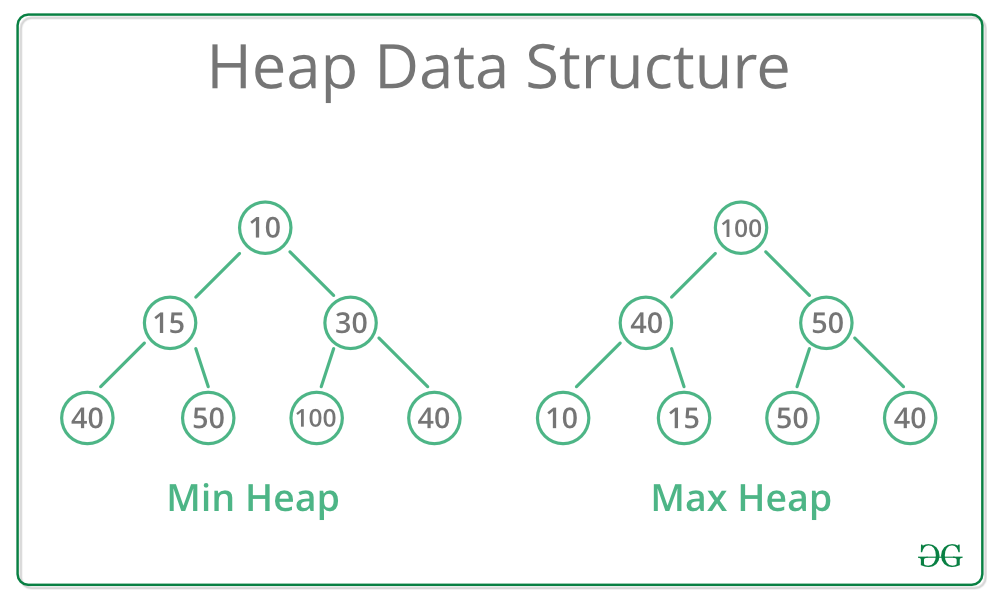
- Parent nodes are always smaller than child nodes
- Each parent has at most two child nodes
- The value of each parent node is always greater than its child nodes
- The parent is greater than the children, but there are no guarantees between sibling nodes.
class MaxHeap {
    constructor() {
        this.array = [null];
    }

    getParent(idx) {
        return Math.floor(idx / 2);
    }

    getLeftChild(idx) {
        return idx * 2;
    }

    getRightChild(idx) {
        return idx * 2 + 1;
} insert(val) {
// add the new node to the bottom level, far-left
this.array.push(val);
// then, sift that value up the heap to restore heap property
this.siftUp(this.array.length - 1);
}
siftUp(idx) {
// if the node is already at the root, there's no further we can sift up
if (idx === 1) return;
let parentIdx = this.getParent(idx);
// if the node is bigger than it's parent, we are breaking heap property...
if (this.array[parentIdx] < this.array[idx]) {
// so swap the node with it's parent
[ this.array[parentIdx], this.array[idx] ] = [ this.array[idx], this.array[parentIdx] ];
// and continue to sift it up recursively
this.siftUp(parentIdx);
}
} deleteMax() {
// recall that we have an empty position at the very front of the array,
// so an array length of 2 means there is only 1 item in the heap
// if there is only 1 element in the heap, simply remove it
if (this.array.length === 2) return this.array.pop();
// if there are no elements in the heap, do nothing
if (this.array.length === 1) return null;
// otherwise remove the last element and make it the root at the front of the array
let max = this.array[1];
this.array[1] = this.array.pop();
// then, sift the new root down to restore heap property
this.siftDown(1);
return max;
}
siftDown(idx) {
let ary = this.array;
let leftIdx = this.getLeftChild(idx);
let rightIdx = this.getRightChild(idx);
let leftVal = ary[leftIdx];
let rightVal = ary[rightIdx];
// if the node is missing children, consider the missing children as the value -Infinity
// this allows the node to keep heap property, since any value is greater than -Infinity
// this will also give us children values to compare later, undefined should not be used for comparison**
if (leftVal === undefined) leftVal = -Infinity;
if (rightVal === undefined) rightVal = -Infinity;
// if the node is bigger than both children, we have restored heap property, so exit
if (ary[idx] > leftVal && ary[idx] > rightVal) return;
// otherwise the node is bigger than one of it's children,
// so swap this node with the bigger between the two children**
if (leftVal < rightVal) {
var swapIdx = rightIdx;
} else {
var swapIdx = leftIdx;
}
[ ary[idx], ary[swapIdx] ] = [ ary[swapIdx], ary[idx] ];
// and continue to sift it down recursively
this.siftDown(swapIdx);
}
- tree - graph with no cycles
- binary tree - tree where nodes have at most 2 nodes
- root - the ultimate parent, the single node of a tree that can access every other node through edges; by definition the root will not have a parent
- internal node - a node that has children
- leaf - a node that does not have any children
- path - a series of nodes that can be traveled through edges - for example A, B, E is a path through the above tree
- Binary trees have at most two children per node
- Given any node of the tree, the values on the left must be strictly less than that node
- Given any node of the tree, the values on the right must be strictly greater than or equal to that node
- Given these constraints a binary tree is necessarily a sorted data structure
- The worst binary trees devolve into a linked list, the best are height balanced (think branching).
class TreeNode {
  constructor(val) {
    this.val = val;
    this.left = null;
    this.right = null;
  }
}

let a = new TreeNode("a");
let b = new TreeNode("b");
let c = new TreeNode("c");
let d = new TreeNode("d");
let e = new TreeNode("e");
let f = new TreeNode("f");

a.left = b;
a.right = c;
b.left = d;
b.right = e;
c.right = f;-
-
- If it is greater or equal to
- Check to see if there is a node to the right
- If there is, move to the new node and continue with the node to the right as the subtree root
- If there is not, add the new node as the right property of the current node
- Check to see if there is a node to the right
- If it is smaller
- Check to see if there is a node to the left
- If there is, move to the new node and continue with the node to the left as the subtree root
- If there is not, add the new node as the left property of the current node
- Check to see if there is a node to the left
- If it is greater or equal to
-
// Start at the root and create a new node
recursiveInsert(val, currentNode = this.root) {
  // Check if there is a root
  if (!this.root) {
    // If not the root becomes the new node
    this.root = new TreeNode(val);
    return this;
  }
  // If it is greater or equal to
  if (val < currentNode.val) {
    // Check to see
    if (!currentNode.left) {
      currentNode.left = new TreeNode(val);
    } else {
      this.insert(val, currentNode.left);
    }
  } else {
    if (!currentNode.right) {
      currentNode.right = new TreeNode(val);
    } else {
      this.insert(val, currentNode.right);
    }
  }
}

iterativeInsert(val, currentNode = this.root) {
  if (!this.root) {
    this.root = new TreeNode(val);
    return this;
  }
  if (val < currentNode.val) {
    if (!currentNode.left) {
      currentNode.left = new TreeNode();
    } else {
      while (true) {
        if (val < currentNode.val) {
          if (!currenNodet.left) {
            currentNode.left = new TreeNode();
            return this;
          } else {
            currentNode = currentNode.left;
          }
        } else {
          if (!currentNode.right) {
            currentNode.right = new TreeNode();
            return this;
          } else {
            currentNode = currentNode.right;
          }
        }
      }
    }
  }
}- Breadth First Search - Check all nodes at a level before moving down a level
- Depth First Search - Check the depth as far as it goes for one child, before
moving on to the next child.
- Pre-Order Traversal - Access the data of the current node, recursively visit the left sub tree, recursively visit the right sub tree
- In-Order Traversal - Recursively visit the left sub tree, access the data of the current node, recursively visit the right sub tree
- Post-Order Traversal - Recursively visit the left sub tree, recursively visit the right sub tree, access the data of the current node.
- Start at the root
- Check if there is a root
- If not, there is nothing in the tree, so the search is over
- If there is a root, check if the value of the root is equal to, greater then, or less then the value were looking for;
- If it is equal to the value
- We found what we are searching for
- If it is less than the value
- Check to see if there is a node to the left
- If there isn't
- the value isn't in our tree
- If there is
- repeat these steps with the node to the left as the new subtree root
- If there isn't
- Check to see if there is a node to the left
- If it is greater than the value
- Check to see if there is a node to the right
- If there isn't
- the value isn't in our tree
- If there is
- repeat these steps with the node to the right as the new subtree root
- If there isn't
- Check to see if there is a node to the right
- If it is equal to the value
- Check if there is a root
class TreeNode {
  constructor(val) {
    this.val = val;
    this.left = null;
    this.right = null;
  }
}

class BST {
  constructor() {
    this.root = null;
  }


  searchRecur(val, currentNode = this.root) {
    if (!currentNode) return false;
    if (val < currentNode.val) {
      return this.searchRecur(val, currentNode.left);
    } else if (val > currentNode.val) {
      return this.searchRecur(val, currentNode.right);
    } else {
      return true;
    }
  }

  searchIter(val) {
    let currentNode = this.root;
    while (currentNode) {
      if (val < currentNode.val) {
        currentNode = currentNode.left;
      } else if (val > currentNode.val) {
        currentNode = currentNode.right;
      } else {
        return true;
      }
    }
    return false;
  }

  // Maybe works, who knows, pulled it off the internet....

  deleteNodeHelper(root, key) {
    if (root === null) {
      return false;
    }
    if (key < root.val) {
      root.left = deleteNodeHelper(root.left, key);
      return root;
    } else if (key > root.val) {
      root.right = deleteNodeHelper(root.right, key);
      return root;
    } else {
      if (root.left === null && root.right === null) {
        root = null;
        return root;
      }
      if (root.left === null) return root.right;
      if (root.right === null) return root.left;

      let currNode = root.right;
      while (currNode.left !== null) {
        currNode = currNode.left;
      }
      root.val = currNode.val;
      root.right = deleteNodeHelper(root.right, currNode.val);
      return root;
    }
  }

  //Types of Depth First Search

  preOrderTraversal(root) {
    if (!root) return [];
    let left = this.preOrderTraversal(root.left);
    let right = this.preOrderTraversal(root.right);
    return [root.val, ...left, ...right];
  }

  preOrderTraversalV2(root) {
    if (!root) return [];
    let newArray = new Array();
    newArray.push(root.val);
    newArray.push(...this.preOrderTraversalV2(root.left));
    newArray.push(...this.preOrderTraversalV2(root.right));
    return newArray;
  }

  inOrderTraversal(root) {
    if (!root) return [];
    let left = this.inOrderTraversal(root.left);
    let right = this.inOrderTraversal(root.right);
    return [...left, root.val, ...right];
  }

  inOrderTraversalV2(root) {
    if (!root) return [];
    let newArray = new Array();
    newArray.push(...this.inOrderTraversalV2(root.left));
    newArray.push(root.val);
    newArray.push(...this.inOrderTraversalV2(root.right));
    return newArray;
  }

  postOrderTraversal(root) {
    if (!root) return [];
    let left = this.postOrderTraversal(root.left);
    let right = this.postOrderTraversal(root.right);
    return [...left, ...right, root.val];
  }

  postOrderTraversalV2(root) {
    if (!root) return [];
    let newArray = new Array();
    newArray.push(...this.postOrderTraversalV2(root.left));
    newArray.push(...this.postOrderTraversalV2(root.right));
    newArray.push(root.val);
    return newArray;
  }

  //Breadth First Search

  breadthFirstSearch(root) {
    let queue = [root];
    let result = [];
    while (queue.length) {
      let current = queue.shift();
      if (current.left) queue.push(current.left);
      if (current.right) queue.push(current.left);
      current.push(result);
    }
    return result;
  }
}- A graph data structure is a collection of nodes and connections represented as pairs
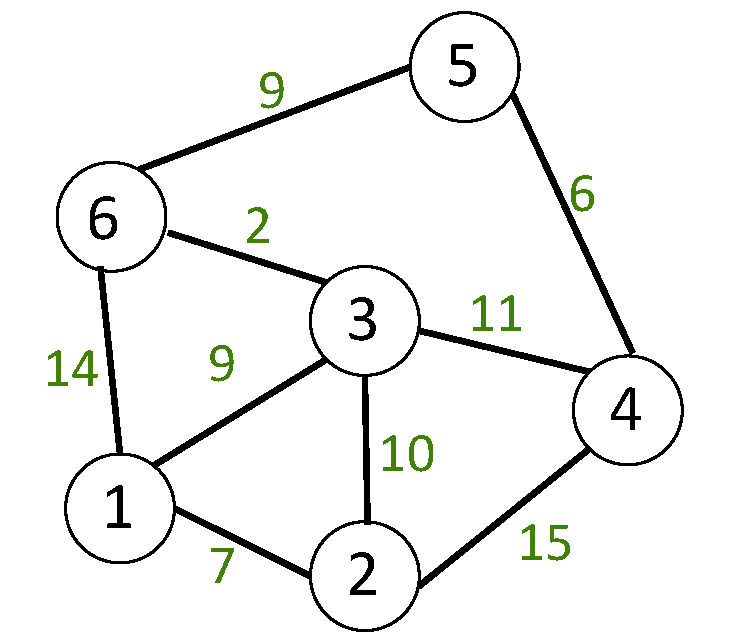
- A graph may:
- lack a root node
- have cycles
- have any number of edges leaving a node

- Graph 1 lacks a root.
- There is no single node that can access all other nodes in a path through edges.
- Graph 2 has a cycle
- There is no longer a parent-child relationship.
- Graph 3 features nodes that have more than 2 edges
- Social Networks
- Location/ Mapping
- Routing Algorithms
- Visual Hierarchy
- File System Optimizations
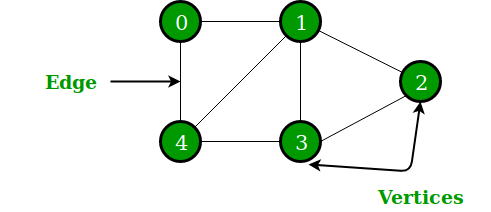
- Vertex - a node
- Edge - connection between nodes
- Weighted/Unweighted - values assigned to distances between vertices
  class GraphNode {
      constructor(val) {
          this.val = val;
          this.neighbors = [];
      }
  }

  let a = new GraphNode('a');
  let b = new GraphNode('b');
  let c = new GraphNode('c');
  let d = new GraphNode('d');
  let e = new GraphNode('e');
  let f = new GraphNode('f');
  a.neighbors = [b, c, e];
  c.neighbors = [b, d];
  e.neighbors = [a];
f.neighbors = [e];function buildGraph(edges) {
let graph = {};
edges.forEach((edge) => {
let [dest, src] = edge.map(String);
if (dest in graph) {
graph[dest].push(src);
} else {
graph[dest] = [src]
}
})
}- Nodes in graph
  class Graph{
    constructor(){
      this.adjacencyList = {};
    }
    // Should accept a name of a vertex
    addVertex(vertex){
      // Should add a key to the adjacency list with the name of the vertex and set its value to be an empty array
      if(!this.adjacencyList[vertex]) this.adjacencyList[vertex] = [];
    }
}// Should accept a vertex to remove
removeVertex(vertex){
// Loop through list as long as there are any other vertices for that vertex
while(this.adjacencyList[vertex].length){
const adjacencyVertex = this.adjacencyList[vertex].pop();
// remove vertex and any values in the adjacency list for that vertex
this.removeEdge(vertex, adjacencyVertex);
}
// delete the key in the adjacency list for that vertex
delete this.adjacencyList[vertex]
}- Connections between nodes
// Should accept two vertices
addEdge(v1, v2){
  // Find in the list, the key of v1 and push v2 to the array
  this.adjacencyList[v1].push(v2);
  // Find in the list, the key of v2 and push v1 to the array
  this.adjacencyList[v2].push(v1);
}// Should accept two vertices
removeEdge(v1, v2) {
// Reassign the key of v1 to be an array that does not contain v2
this.adjacencyList[v1] = this.adjacencyList[v1].filter(v => v !== v2);
// Reassign the key of v2 to be an array that does not contain v1
this.adjacencyList[v2] = this.adjacencyList[v2].filter(v => v !== v1);
}function breadthFirst(startingNode, targetVal) {
let queue = [startingNode];
let visited = new Set();
while (queue.length) {
let node = queue.shift();
if (visited.has(node)) continue;
visited.add(node);
if (node.val === targetVal) return node;
queue.push(...node.neighbors)
}
return null;
}
function breadthFirst(start){
const queue = [start];
const result = [];
const visited = {};
while(queue.length){
let node = queue.shift();
result.push(node);
this.adjacencyList[node].forEach((neighbor) => {
if(!visited.neighbor) {
visited[neighbor] = true;
queue.push(neighbor)
}
})
}
}function depthFirst(node, visited = new Set()) {
if (visited.has(node.val)) return;
visited.add(node.val)
node.neighbors.forEach(neighbor => depthFirst(neighbor, visited))
}// Should accept a starting node
function depthFirst(start) {
// Create a stack to help keep track of vertices(use a list/array) & add the starting vertex to it
const stack = [start];
// Create a list to store the end result, to be returned at the end
const result = [];
// Create an object to store visited vertices
const visited = {};
let currentVertex;
visited[start] = true;
// While the stack has something in it
while(stack.length){
console.log(stack);
// Remove the next next vertex from the stack
currentVertex = stack.pop();
// add it to the result list
result.push(currentVertex);
this.adjacencyList[currentVertex].forEach((neighbor) => {
// If that vertex hasn't been visited yet:
if(!visited[neighbor]) {
// mark it as visited
visited[neighbor] = true;
// push all of its neighbors into the stack
stack.push(neighbor)
}
});
}
return result;
}function depthFirst(graph, node, visited = new Set()){
if (visited.has(node)) return;
graph[node].forEach((neighbor) => depthFirst(graph, neighbor, visited))
visited.add(node)
}