
MOdel Consistency with Context Augmentation for VIew-based systems
A research project at KIT · Context models · Consistency analysis · AI-assisted development
Research scope · In Vitruvius · The metamodel · Code & prototypes · Contact

Consistency judgments can depend on deployment, intended use and data-handling assumptions that are absent from the system model. MOCCAVI investigates how to represent these assumptions explicitly and reuse them across consistency mechanisms. The research examines their effects on analysis results, modelling effort and software development.
Consider a driver-monitoring system that shares data with a backend. Changing the processing purpose or retention assumptions can change the obligations a check must consider, even if the architecture stays the same.
In the proposed design, the context model participates in the V-SUM of Vitruvius alongside the artifact models. MOCCAVI investigates how to derive inputs for different consistency mechanisms from this shared basis and coordinate their findings without losing scope or provenance.
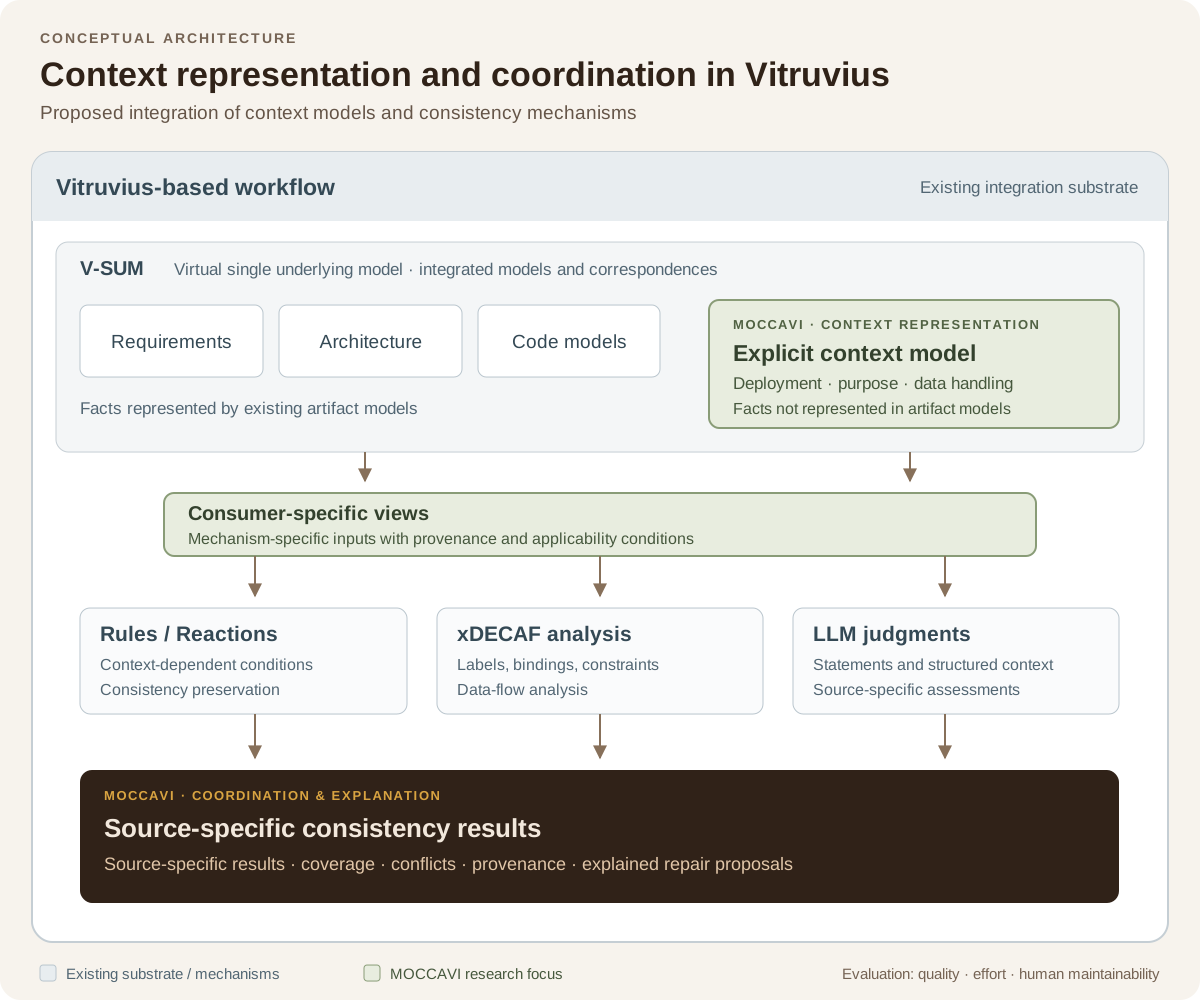
Conceptual research design: the highlighted areas show MOCCAVI’s research focus; Vitruvius and the checking mechanisms provide the substrate. Select the diagram to inspect it at full resolution.
- Context representation: representations, elicitation and extraction of context from existing models; semantic fidelity, reuse and provenance under change.
- Consistency coordination: shared semantics for rules, external analyses and LLM judgments; coverage gaps, abstentions, conflicts and the justification of repair proposals.
- Empirical evaluation: verdict quality and total modelling effort relative to baselines; sensitivity to reference cases, transfer to other systems and limits of applicability.
- AI reliability: errors and correction effort in context authoring, consistency judgment and rule synthesis; effects of specifications and execution feedback.
- AI coding through models: how agents use Vitruvius model views to generate and evolve software; effects on functional correctness, model–code consistency, lifecycle effort and human maintainability.
The evaluation uses context comparisons, baselines and independently justified reference cases.
The design connects MOCCAVI to different parts of the framework: model access through views, context inside the V-SUM, coordination around change propagation, and candidate rule generation for Reactions. AI-assisted rule synthesis and AI coding through existing models are distinct activities.
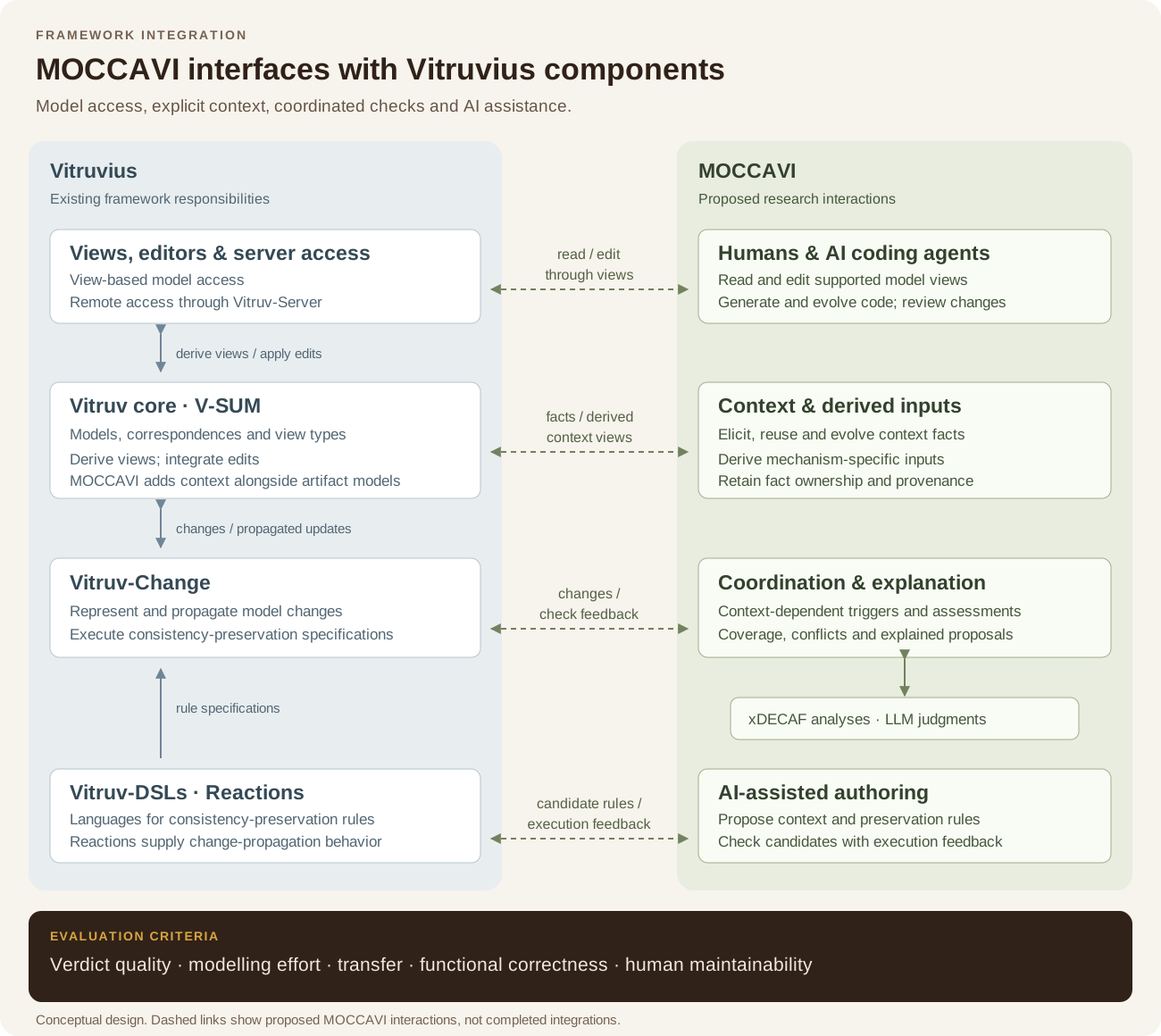
Blue identifies existing Vitruvius components; green identifies MOCCAVI’s proposed interactions. Arrows describe conceptual responsibilities, not deployed API connections. Framework component roles follow the Vitruvius documentation.
The proposed metamodel below explores how explicit context can extend xDECAF data-flow analysis.
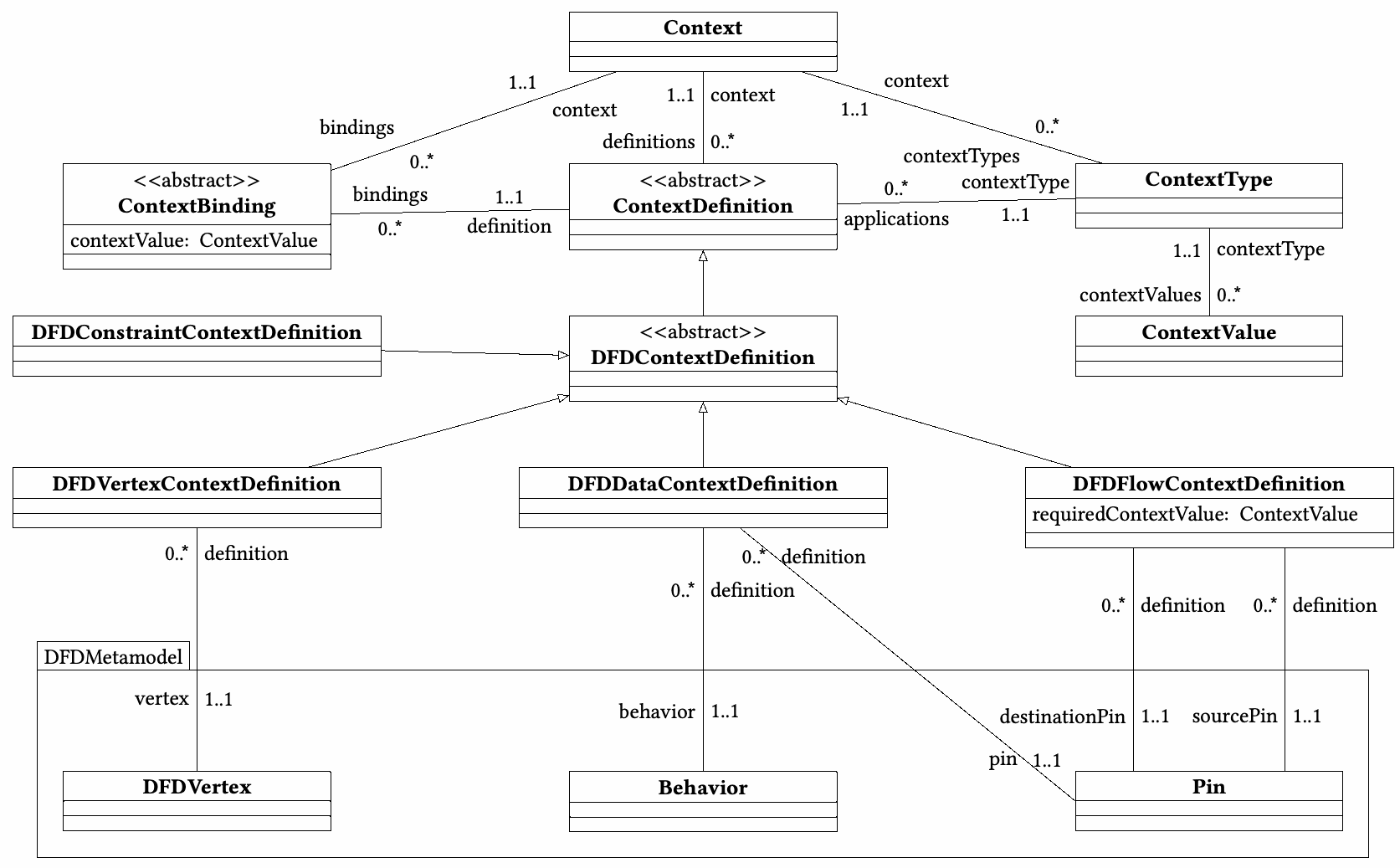
Proposed structure, not a finalized API. Select the figure to inspect it at full resolution.
| Concept | What it expresses |
|---|---|
| ContextType / ContextValue | A context dimension and its possible values. |
| ContextDefinition | Where and how context applies to the referenced model or analysis. |
| ContextBinding | A concrete value assigned to a context definition. |
| DFD-specific definitions | Context affecting vertex labels, data labels, flows or analysis constraints. |
The proposed extension loads context alongside system models, accounts for it when extracting and annotating data flows, and checks the resulting constraints. Unbound definitions motivate exploration of possible context values.

Research in progress. The repositories contain prototypes and study artifacts with their respective setup instructions and limitations.
- moccavi-web — An early interface for context, models and consistency results. Its context evaluator recomputes verdicts; several surrounding services use demo fixtures.
- ConsistencyDeepAgent — Agentic synthesis of Vitruvius Reactions from OCL specifications, with compilation, testing and diagnostic feedback.
- LowCodeConsistencyAI — Low-code application variants with and without LLM-based consistency-preservation assistance.
Vitruvius provides the view-based integration substrate. xDECAF provides architecture-based data-flow analysis for information security. MOCCAVI builds on these systems; they are not new MOCCAVI contributions.
Benjamin Arp · Karlsruhe Institute of Technology (KIT)
KASTEL – Institute of Information Security and Dependability · DSiS / SDQ
Research embedded in CRC 1608 CONVIDE.
Project questions and use cases.
MOCCAVI · pronounced “mo-KAH-vee” · Check each repository for its license. Figure and image sources are documented in asset provenance.
