
A production-grade integration of backtest-kit that replaces the default file-based
./dump/persistence with PostgreSQL as the source of truth and Redis as an O(1) lookup cache, packaged withdocker-composefor one-command deploys.
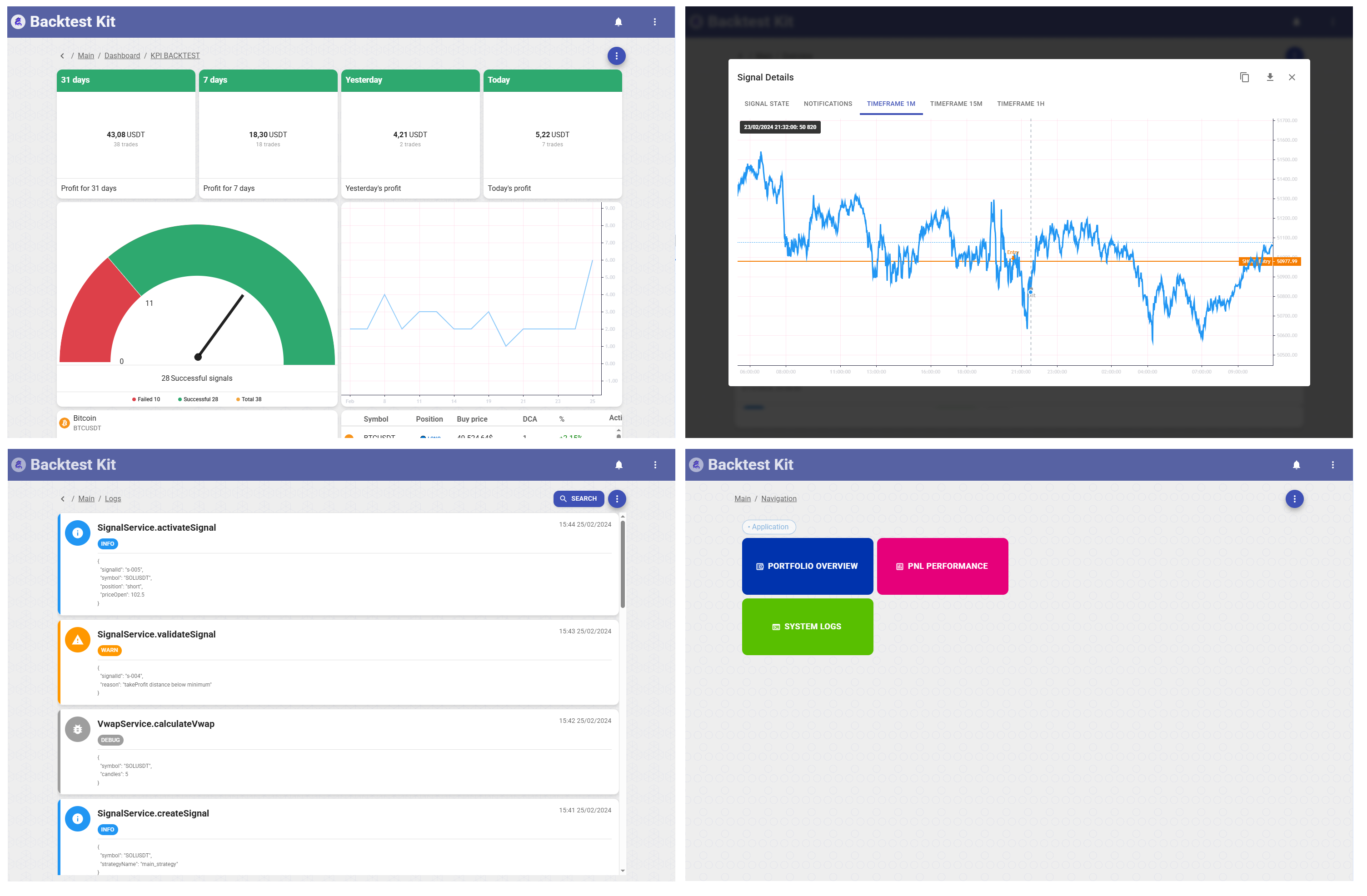




This project ships 16 custom Persist adapters that implement the full backtest-kit IPersist*Instance contract on top of PostgreSQL (via TypeORM) + Redis. Strategy code, runners, and the CLI entrypoint stay unchanged — only the persistence layer is swapped.
📚 API Reference | 🌟 Quick Start | 📰 Article
Start the PostgreSQL cluster and Redis in containers:
docker-compose -f docker/pgpool/docker-compose.yaml up -d
docker-compose -f docker/redis/docker-compose.yaml up -d
docker/pgpool boots a whole cluster — 1 primary + 2 streaming replicas behind Pgpool-II — on :5432 (see Docker Layout). The app connects to that single port; writes go to the primary, reads are load-balanced across the replicas. First boot takes ~60–90 s while the replicas clone.
Run a backtest:
npm run start -- --entry --backtest --ui ./build/index.cjsLive mode:
npm run start -- --entry --live --ui ./build/index.cjsPaper mode:
npm run start -- --entry --paper --ui ./build/index.cjsBundles the strategy, runner, and backtest-kit container together. Reads MODE from env (backtest | live | paper):
MODE=backtest ENTRY=1 UI=1 STRATEGY_FILE=./build/index.cjs docker-compose up -d
docker-compose logs -f
Or via npm script:
npm run start:docker
npm run stop:dockerEach adapter implements the corresponding IPersist*Instance interface from backtest-kit and is registered in src/config/setup.ts. All adapters share the same skeleton:
PersistXAdapter.usePersistXAdapter(class implements IPersistXInstance {
  constructor(/* context fields from backtest-kit */) {}
  async waitForInit(initial: boolean) {
    if (!initial) return;
    await waitForInfra();        // gate first-touch on Postgres + Redis ready
  }
  async readXData(...) { return await ioc.xDbService.findByContext(...); }
  async writeXData(..., when: Date) { await ioc.xDbService.upsert(..., when); }
});| Adapter | Table | Context key (= unique index) | Purpose |
|---|---|---|---|
| Candle | candle-items |
(symbol, interval, timestamp) |
OHLCV cache; immutable inserts |
| Signal | signal-items |
(symbol, strategyName, exchangeName) |
Live signal state per context |
| Schedule | schedule-items |
(symbol, strategyName, exchangeName) |
Pending scheduled signal |
| Strategy | strategy-items |
(symbol, strategyName, exchangeName) |
Persistent strategy state per context |
| Risk | risk-items |
(riskName, exchangeName) |
Active risk positions snapshot |
| Partial | partial-items |
(symbol, strategyName, exchangeName, signalId) |
Partial profit/loss levels per signal |
| Breakeven | breakeven-items |
(symbol, strategyName, exchangeName, signalId) |
Breakeven reached flag |
| Storage | storage-items |
(backtest, signalId) |
Closed/opened signal log per mode |
| Notification | notification-items |
(backtest, notificationId) |
Event notifications |
| Log | log-items |
(entryId) |
Strategy log entries |
| Measure | measure-items |
(bucket, entryKey) |
LLM/API response cache (soft-delete) |
| Interval | interval-items |
(bucket, entryKey) |
Once-per-interval markers (soft-delete) |
| Memory | memory-items |
(signalId, bucketName, memoryId) |
Per-signal memory store (soft-delete) |
| Recent | recent-items |
(symbol, strategyName, exchangeName, frameName, backtest) |
Last public signal per context |
| State | state-items |
(signalId, bucketName) |
Per-signal state buckets |
| Session | session-items |
(strategyName, exchangeName, frameName, symbol, backtest) |
One session per running strategy |
backtest-kit is designed with a write durability contract: after writeXData(...) returns, the very next readXData(...) must see the just-written value. The default file-based persist satisfies this trivially via fs.writeFile + fs.readFile. A naïve SQL implementation — findByContext → if existing update else insert — does not satisfy this contract under concurrent access: two parallel writers both see "no existing row", both attempt insert, the second one crashes with a unique-constraint violation. The framework then re-fetches from the exchange, retries the write, loops forever, or silently corrupts state.
Every upsert in this project goes through a single atomic round-trip to PostgreSQL — one INSERT … ON CONFLICT … DO UPDATE … RETURNING * statement, no read-then-write:
// from src/lib/services/db/SignalDbService.ts
public upsert = async (symbol, strategyName, exchangeName, payload) => {
  const repo = await this.repo<ISignalRowDoc>();
  const { raw } = await repo
    .createQueryBuilder()
    .insert()
    .values({ symbol, strategyName, exchangeName, payload })
    .orUpdate(["payload"], ["symbol", "strategyName", "exchangeName"])  // conflict target = unique index
    .returning("*")
    .execute();
  const result = raw[0] as ISignalRowDoc;
  await this.signalCacheService.setSignalId(result);     // Redis: ctx-key → id
};
Key properties of this pattern:
- Conflict target == unique index shape. Every table has a unique compound index whose columns are exactly the context key fields. PostgreSQL serializes concurrent inserts on that key at the storage engine level — the loser of the race takes the
DO UPDATEbranch instead of throwing, so no unique-violation ever leaks to the application. DO UPDATE SET payload = EXCLUDED.payload, not a no-op. Subsequent writes to the same context key are real updates. The exception isCandleDbService, where candles are immutable: it uses a no-opDO UPDATE SET symbol = EXCLUDED.symbolso the OHLCV columns are never overwritten while the row is still returned (insert-only, but always readable).RETURNING *yields the just-written row in the same statement. Its id is fed to the Redis cache immediately, so the nextfindByContextis O(1) — and, crucially, the cache is seeded from the returned row, never from a follow-upSELECTthat could be routed to a lagging replica.- uuid primary keys with
gen_random_uuid()and TypeORMcreateDate/updateDatecolumns are applied on insert automatically — no application-side id or timestamp bookkeeping.
For soft-delete operations (Measure, Interval, Memory), a parallel atomic pattern is used — a single server-side UPDATE with jsonb_set, never a read-modify-write:
public softRemove = async (bucket, entryKey) => {
  const repo = await this.repo<IIntervalRow>();
  const { raw } = await repo
    .createQueryBuilder()
    .update()
    .set({
      removed: true,
      payload: () => `jsonb_set("payload", '{removed}', 'true')`,  // flag flipped in-place, server-side
    })
    .where({ bucket, entryKey })
    .returning("*")
    .execute();
  const saved = raw[0];
  if (saved) await this.intervalCacheService.setIntervalId(saved);
};
The row is never physically deleted — listKeys filters on removed = false to skip tombstones. Because the new value is computed on the server (jsonb_set) inside one statement, there is no SELECT-then-save window where a concurrent upsert could be lost. This mirrors the soft-delete semantics of the default file-based PersistMeasureInstance / PersistIntervalInstance / PersistMemoryInstance.
There is a subtle trap that only surfaces on a cluster. A lone PostgreSQL instance is one process: all concurrency is arbitrated internally by row locks and MVCC — effectively "atomicity through one global mutex". On such a node, even a sloppy write followed by a separate SELECT appears correct, because that SELECT hits the very same process that just committed. It looks atomic.
Add read replicas and the illusion breaks. Writes go to the primary, but reads are load-balanced onto asynchronous replicas that lag behind by a few milliseconds. Now a write + follow-up SELECT can be routed to a replica that has not yet received the commit, and the read returns a stale value (or relation does not exist right after schema creation) — silently violating the read-after-write contract. Code that passed every test on a single node corrupts state in production.
This is exactly why the two patterns above never do a follow-up read: the written row comes back in the same statement via RETURNING, and the Redis cache is seeded from it. It is also why the dev environment (docker/pgpool) runs a real cluster with two replicas rather than a single Postgres container — so any accidental read-after-write dependency is caught in development, not in prod. A one-node dev database would hide it behind the global-mutex illusion.
PostgreSQL queries on an indexed compound key are fast (O(log n) on the B-tree), but backtest-kit performs thousands of read-by-context-key per second during backtests. Redis turns that into O(1) lookups.
For each domain there is a *CacheService that extends BaseMap (src/lib/common/BaseMap.ts) — a thin wrapper around ioredis that gives a string-keyed map API (get, set, delete, has, keys, values, toArray, iterate, size) on top of Redis keys namespaced by a service prefix. The cache stores only the row's id (a uuid string), never the document itself.
// src/lib/services/cache/SignalCacheService.ts
const REDIS_KEY = "signal_cache";

export class SignalCacheService extends BaseMap(REDIS_KEY, -1) {  // -1 = no TTL
  private _cacheKey(symbol, strategyName, exchangeName) {
    return `${exchangeName}:${strategyName}:${symbol}`;
  }
  public async getSignalId(symbol, strategyName, exchangeName) {
    return <string>await super.get(this._cacheKey(...)) ?? null;
  }
  public async setSignalId(row) {
    await super.set(this._cacheKey(row.symbol, row.strategyName, row.exchangeName), row.id);
    return row.id;
  }
}public findByContext = async (symbol, strategyName, exchangeName) => {
const cachedId = await this.signalCacheService.getSignalId(...);
if (cachedId) {
const cached = await super.findByFilter({ id: cachedId }); // ← O(1) Redis + PK lookup
if (cached) return cached;
}
// Cache miss: fall back to Postgres by full filter, then backfill Redis.
const result = await super.findByFilter({ symbol, strategyName, exchangeName });
if (result) await this.signalCacheService.setSignalId(result);
return result;
};- Cache hit (steady state): one Redis
GET+ one Postgres lookup by primary key — both O(1) - Cache miss (cold start, eviction, Redis restart): one Postgres
SELECTby indexed filter + one RedisSETto backfill - After
upsert: the cache is updated synchronously from theRETURNINGrow in the same critical section, so the nextfindByContextalways hits the cache
backtest-kit 9.0+ added a when: Date argument to every adapter write* method (and to read* for adapters that affect signal logic: Risk, Partial, Breakeven). The argument carries the logical simulation timestamp at which the write happens.
For adapters that touch signal-affecting state (Risk, Partial, Breakeven, Recent, State, Session, Memory, Interval), the corresponding entity has a when column stored as bigint (epoch milliseconds). A shared ValueTransformer keeps the JS-visible value a plain number, since the pg driver returns bigint as a string:
// src/schema/State.schema.ts
const StateModel = new EntitySchema<IStateRow>({
  name: "state-items",
  columns: {
    id: { type: "uuid", primary: true, generated: "uuid" },
    signalId: { type: String },
    bucketName: { type: String },
    payload: { type: "jsonb" },                                  // typed by the domain payload
    when: { type: "bigint", transformer: epochTransformer },     // ms since epoch, read back as number
    createDate: { type: "timestamptz", createDate: true },
    updatedDate: { type: "timestamptz", updateDate: true },
  },
  indices: [{ name: "state_items_uq", columns: ["signalId", "bucketName"], unique: true }],
});
The DbService converts Date → ms and writes it in the same atomic upsert:
public upsert = async (signalId, bucketName, payload, when) => {
  const repo = await this.repo<IStateRow>();
  const { raw } = await repo
    .createQueryBuilder()
    .insert()
    .values({ signalId, bucketName, payload, when: when.getTime() })
    .orUpdate(["payload", "when"], ["signalId", "bucketName"])
    .returning("*")
    .execute();
  // ...
};
This lets backtest-kit's internal look-ahead-bias filter (which lives upstream of the adapter) verify that no read returns a value with when > current_simulation_time. Measure is intentionally exempt — it caches LLM responses where look-ahead bias is not applicable.
docker/
  pgpool/docker-compose.yaml    # all-in-one cluster: primary + 2 replicas + Pgpool-II on :5432
  postgres/docker-compose.yaml  # single postgres:16-alpine on :5432 (simple/CI use)
  redis/docker-compose.yaml     # redis:7.4.1 on :6379, password=mysecurepassword
docker-compose.yaml             # main: backtest-kit container, mounts project as /workspace
The main docker-compose.yaml uses extra_hosts: host.docker.internal:host-gateway so the container reaches PostgreSQL and Redis on the host machine. Use host.docker.internal instead of 127.0.0.1 in your connection strings, or override via .env if your infrastructure runs elsewhere:
CC_POSTGRES_CONNECTION_STRING=postgres://backtest:mysecurepassword@prod-postgres:5432/backtest-pro
CC_REDIS_HOST=prod-redis
CC_REDIS_PORT=6379
CC_REDIS_USER=default
CC_REDIS_PASSWORD=...
The schema is created automatically on first connect (TypeORM synchronize: true), so there is no manual migration step — the tables and unique indexes appear when the app boots against an empty database.
Container env vars consumed by @backtest-kit/cli:
| Var | Purpose |
|---|---|
MODE |
backtest | live | paper |
STRATEGY_FILE |
Path to compiled strategy bundle (default: ./build/index.cjs) |
ENTRY |
Set to 1 to actually run (matches --entry flag in CLI mode) |
SYMBOL, STRATEGY, EXCHANGE, FRAME |
Override strategy context |
UI |
Enable web UI on :60050 |
TELEGRAM, VERBOSE, NO_CACHE, NO_FLUSH |
Standard backtest-kit CLI flags |
Healthcheck pings http://localhost:60050/api/v1/health/health_check every 30s.
The actual trading logic lives outside the persistence layer — see src/logic/strategy/ and src/logic/frame/ for examples, and modules/ for the ccxt exchange adapter registration. Mode-specific entry points in src/main/ gate on CLI args from src/helpers/getArgs.ts:
// src/main/backtest.ts
const main = async () => {
  const { values } = getArgs();
  if (!values.entry || !values.backtest) return;

  await ioc.postgresService.waitForInit();
  await ioc.redisService.waitForInit();
  await waitForReady(true);

  await warmCandles({ exchangeName: ExchangeName.CCXT, /* ... */ });

  Backtest.background("TRXUSDT", {
    exchangeName: ExchangeName.CCXT,
    frameName: FrameName.Jan2026Frame,
    strategyName: StrategyName.Jan2026Strategy,
  });
};